
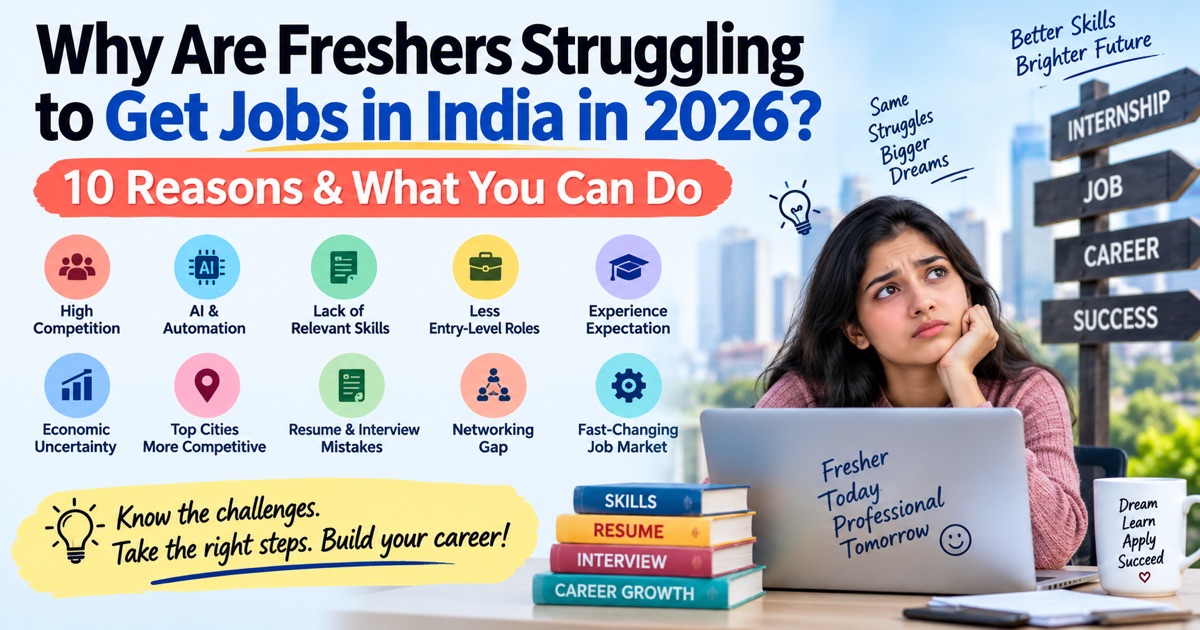
If you've sent out dozens of applications and heard nothing back, you're not imagining it — fresher hiring really has gotten harder. Only about 14% of new hires across Indian industries in 2025 were freshers, down from nearly 19% the year before, even as the number of open vacancies keeps growing. That gap between "jobs exist" and "freshers aren't getting them" is the real story of 2026.
Here are the 10 reasons behind it — and a concrete action for each one, not just an explanation.
1. Most Graduates Aren't Actually Job-Ready
By some estimates, only around 4 in 10 Indian graduates currently have the skills employers are actually hiring for. Universities are still built around theoretical exams, while workplaces expect hands-on technical skills, problem-solving, and digital literacy from day one.
What to do: Don't wait for your degree to teach you what employers want. Pick one practical skill relevant to your target role and build real, demonstrable proficiency in it before you graduate, not after.
2. Soft Skills Are a Bigger Filter Than You Think
Roughly a quarter of employers reject fresher candidates specifically over soft-skill gaps — communication, client interaction, and the ability to explain your own thinking clearly.
What to do: Practice explaining your projects and coursework out loud, to a friend or even to yourself. Technical ability that you can't communicate in an interview effectively doesn't get you hired.
3. There Simply Aren't Enough Graduate-Level Jobs to Go Around
India produces roughly 5 million graduates a year, but only about 2.8 million graduate-level jobs open up annually. This is a structural supply-demand gap, not a personal failing — a meaningful share of graduates are competing for a fixed, smaller pool of roles no matter how strong their resume is.
What to do: Widen your definition of a "good" first job. Adjacent roles, smaller companies, and fast-growing sectors like insurance and BPO/ITES are hiring aggressively right now and offer real paths upward, even if they weren't your first choice.
4. Fresher Hiring Has Genuinely Declined
As mentioned above, the fresher share of new hires dropped from nearly 19% to about 14% in a single year. Employers are leaning more on experienced hires to reduce onboarding time and risk in an uncertain market.
What to do: Anything that reduces an employer's perceived "risk" in hiring you — internships, certifications, real projects — makes you a safer bet against more experienced candidates. Build that evidence deliberately.
5. Salary Expectations Don't Match Entry-Level Reality
About 73% of undergraduates are targeting salaries above ₹5 LPA for their first job, but only around 40% of fresher offers actually reach that number. Some of what feels like "no jobs available" is really a mismatch between expectation and typical entry-level pay.
What to do: Treat your first role as building a track record, not maximizing day-one salary. A realistic first offer with real growth potential usually beats holding out for a number that most freshers aren't getting anyway.
6. Believing a Degree Alone Is Enough
Around 65% of freshers still believe a degree by itself should be sufficient for a well-paying job — yet only about 30% have pursued any certification or hands-on training beyond their coursework.
What to do: Treat certifications and self-directed projects as mandatory, not optional extras. In a skills-first hiring market, they're often what actually gets you shortlisted.
7. AI Is Automating a Real Share of Entry-Level Work
AI tools are now handling an estimated 37% of tasks that used to sit at the entry level — first-pass data entry, basic documentation, simple debugging, and similar repetitive work that used to be a fresher's way into a company.
What to do: Position yourself as someone who can work alongside AI tools, not someone competing with them. Basic fluency with AI tools relevant to your field is quickly becoming a baseline expectation, not a bonus skill.
8. Your Resume May Never Reach a Human
Many fresher resume templates hide skills and experience inside formatting, tables, or graphics that automated screening systems can't read at all — meaning a genuinely qualified candidate gets filtered out before anyone sees it.
What to do: Use a clean, simple format with standard section headings and no text embedded in images or complex tables. When in doubt, simpler and more literal beats "creative" formatting.
9. No Proof of Work Beyond a Transcript
A candidate with two or three real, deployed projects — even small ones, visible on GitHub or a simple portfolio — consistently outperforms a candidate with a longer list of certificates and nothing tangible to show for them.
What to do: Before your next application round, make sure you have at least one project you can actually show and talk through in detail, not just list as a bullet point.
10. Skills Are Changing Faster Than Freshers Can Track
A large share of job seekers say they feel genuinely unprepared for how quickly required skills are shifting — and at the same time, a majority of recruiters say they struggle to find qualified talent. Both things are true simultaneously: there's real demand, but the specific skills in demand keep moving.
What to do: Follow what's actually being asked for in job postings in your target field right now, not what was standard when you started your degree. Treat your skill set as something to keep updating, not something you finish once.